Analysis
Golf Course Rating and Slope: Numbers Made Simple
By harrycolson
November 14, 2026
Field Notes
Think par tells you how hard a course is? It doesn’t. Those two numbers on the scorecard do.
Course Rating and Slope might look like boring decimals, but they tell you what a scratch golfer should score and how much tougher the course gets for a bogey player.
Read on and you’ll learn, in plain terms, what 72.4/129 actually means, how those numbers change your Course Handicap, and why they should decide which tees you play, not ego.
What Do Course Rating and Slope Numbers Mean?
Course Rating tells you what a scratch golfer is expected to shoot on a given set of tees. Slope Rating is answering something else entirely: how much tougher those same tees play for a bogey golfer compared to that scratch player. Two different questions, two different numbers, and that’s exactly why your scorecard lists both instead of just picking one.
A scratch golfer carries a Handicap Index of 0. That’s the baseline the whole system gets built around. The bogey golfer is the other reference point, a higher handicap player (around a 20 Handicap Index for men, with a slightly different standard for women) that raters use to see how difficulty ramps up for the rest of us. Course Rating only looks at that scratch player. Slope looks at the gap between the two.
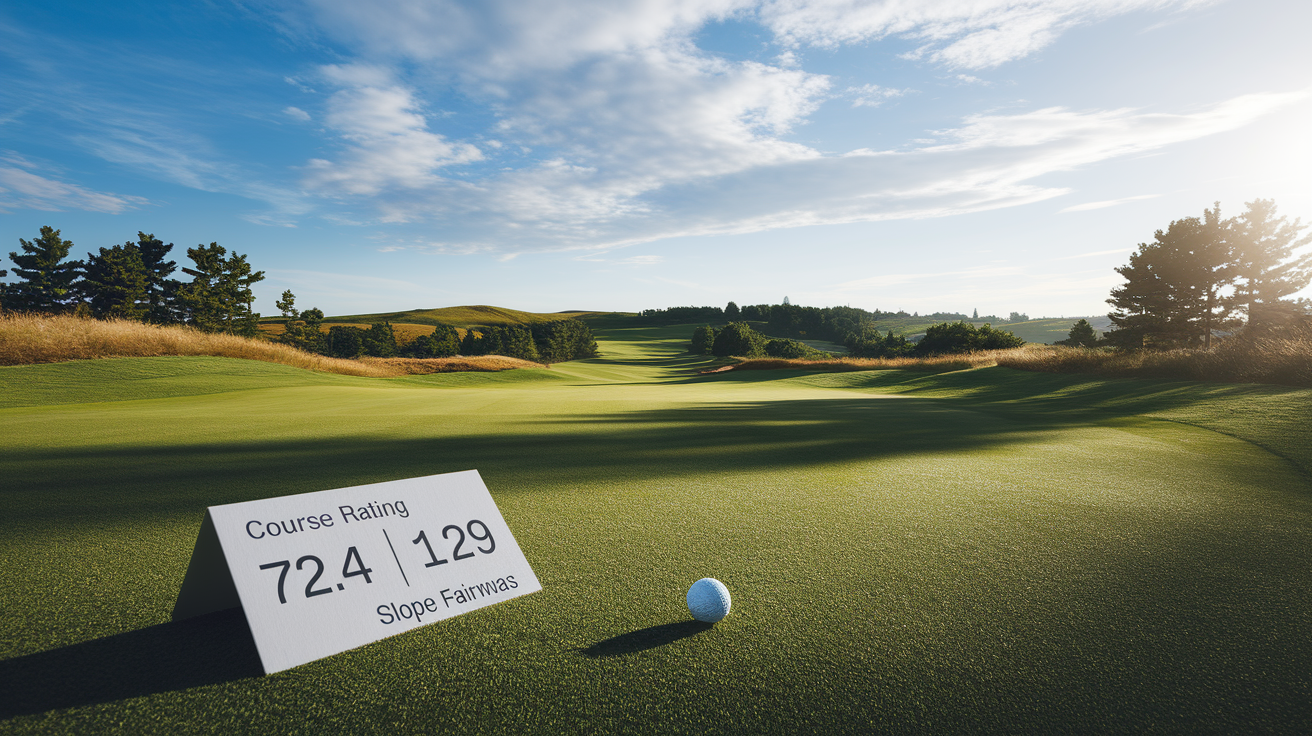
So when you spot something like “72.4/129” next to a tee box, here’s the breakdown. The 72.4 is what a scratch golfer should shoot, and you can compare that to par to see if the course plays harder or easier than its par suggests. The 129 is a different animal. It tells you that compared to the 113 benchmark, these tees get tougher for a bogey golfer at a faster rate than they do for a scratch golfer. A high Slope doesn’t mean the course beats up everyone equally. It means difficulty climbs steeply the further your game sits from scratch.
| Metric | What It Measures | Display Format | Relationship to Par | Key Benchmark |
|---|---|---|---|---|
| Course Rating | Expected strokes for a scratch golfer | One decimal (e.g., 72.4) | Can be above, equal to, or below par | Compared directly to par |
| Slope Rating | Relative difficulty for a bogey golfer vs. a scratch golfer | Whole number, 55 to 155 | Not based on par at all | 113 is the standard average |
Par alone can’t tell you how a course actually plays across different skill levels. That’s the whole reason both numbers sit on the card together.
How Are Golf Course Rating and Slope Calculated?
(((alt-img2)))
These numbers don’t come from a guess or a quick walk around the property. USGA-authorized rating teams, usually 3 to 4 trained raters, measure the course in person using a standardized process and dedicated software. It’s painstaking work, and it’s not something a club pro or a weekend foursome could pull off on their own.
Raters study the course through two lenses at once: how it plays for a scratch golfer and how it plays for a bogey golfer. Same fairways, same greens, but the obstacles get scored differently depending on who’s hitting the shot.
Measuring Effective Playing Length
Card yardage is only the starting point. Raters adjust for elevation change (uphill holes play longer, downhill holes play shorter), expected roll, doglegs that cut off the straight line, forced layups, and prevailing wind. A 420 yard hole that’s dead uphill into a headwind plays nothing like a flat 420 yard hole, and the effective length has to reflect that.
Evaluating Obstacles for Two Player Standards
- Landing area width, rough thickness, and how hard it is to recover from an off-line shot.
- Bunker depth, location, and how often they actually come into play.
- Water hazards, out of bounds stakes, and any forced carries over trouble.
- Green size, contours, firmness, and how fast the surface runs.
- How each obstacle affects a scratch golfer differently than a bogey golfer. A forced carry that’s routine for a scratch player can be a real gamble for a bogey golfer.
Turning Field Data Into Rating and Slope
Here’s a simplified look at the math, using a 6,600 yard course as an example. The scratch yardage formula (effective length ÷ 220 + 40.9) gives a baseline of 70.9. Add hazard adjustments, say 1.5, and you land on a 72.4 Course Rating. The bogey yardage formula (effective length ÷ 160 + 50.7) produces 92.0, and with its own hazard adjustment of 5.3, that becomes a 97.3 Bogey Rating.
Slope comes from the gap between those two numbers. Subtract Course Rating from Bogey Rating, multiply by 5.381, and you land around 134. That’s your Slope. Official figures always come from authorized associations running this through the standardized system, not from someone’s personal spreadsheet.
How Do Course Rating and Slope Affect Your Handicap?
(((alt-img3)))
Here’s the thing: your Handicap Index travels with you, but every course plays differently. Course Rating and Slope are what turn that portable number into a Course Handicap specific to the tees you’re actually playing. Under the World Handicap System, which unified these formulas back on January 1, 2020, this conversion happens every single time you tee it up somewhere new.
Without this step, a 14 Handicap Index would mean something totally different on an easy municipal track versus a long, hazard-filled resort course. Slope and Course Rating keep that number in your pocket meaningful no matter where you play.
Converting Handicap Index Into Course Handicap
The current formula is:
Course Handicap = Handicap Index × (Slope Rating ÷ 113) + (Course Rating − Par)
Let’s walk through it with a 14.3 Handicap Index on tees rated 72.4/129, par 72.
- Divide 129 by 113, which gives you 1.1416.
- Multiply that by 14.3, giving you 16.33.
- Add 72.4 minus 72, which is 0.4, bringing the total to 16.73.
- Round 16.73 up to a Course Handicap of 17.
Final Words
You now know those two numbers: Course Rating predicts a scratch golfer’s score; Slope shows how much harder the course plays for a bogey golfer.
We covered how raters measure length and obstacles, how the World Handicap System turns those numbers into your course handicap, and how to use them to pick tees and plan strategy.
Quick rules: check the exact tee’s Course Rating and Slope, compare Rating with par and Slope with 113, and choose tees that fit your game. With golf course rating and slope explained, you’ll pick smarter tees and play fairer. Play and enjoy.
FAQ
Q: What is the difference between Course Rating and Slope Rating in golf?
A: The difference between Course Rating and Slope Rating is that Course Rating predicts a scratch golfer’s expected strokes from specific tees (to one decimal), while Slope compares how much harder those tees play for a bogey golfer versus a scratch golfer.
Q: What is the 70/30 rule in golf?
A: The 70/30 rule in golf is not an official standard; it’s an informal guideline many golfers use to prioritize practice or focus—often meaning 70% on fundamentals (alignment, setup) and 30% on mechanics or strategy.
Q: What does a slope rating of 130 mean?
A: A slope rating of 130 means the course plays tougher than the 113 benchmark for higher-handicap (bogey) golfers, so relative to a scratch player it will increase the strokes a bogey golfer needs.
Q: Is a 72 Course Rating hard?
A: A 72 Course Rating means a scratch golfer is expected to score about 72 from those tees; whether that’s hard depends on the course par and slope—72 can be equal to, easier than, or harder than par.