Analysis
Seasonal Maintenance Keeps Course Playability Strong All Year
By ds
November 12, 2026
Field Notes

Think a patchy green or sand-speckled fairway means your club is slacking?
Often it means the opposite.
Seasonal maintenance intentionally makes surfaces look and play worse for a short spell — aeration holes, thin turf, slower greens — so the turf grows back stronger, firmer, and more consistent.
This post explains the trade-offs and timing behind those ugly weeks.
You’ll learn why crews pull up speed now to give you steadier roll, better drainage, and durable turf all season.
Knowing this makes that rough week feel a lot less mysterious.
The Short-Term Trade-Off for Healthier Playing Surfaces
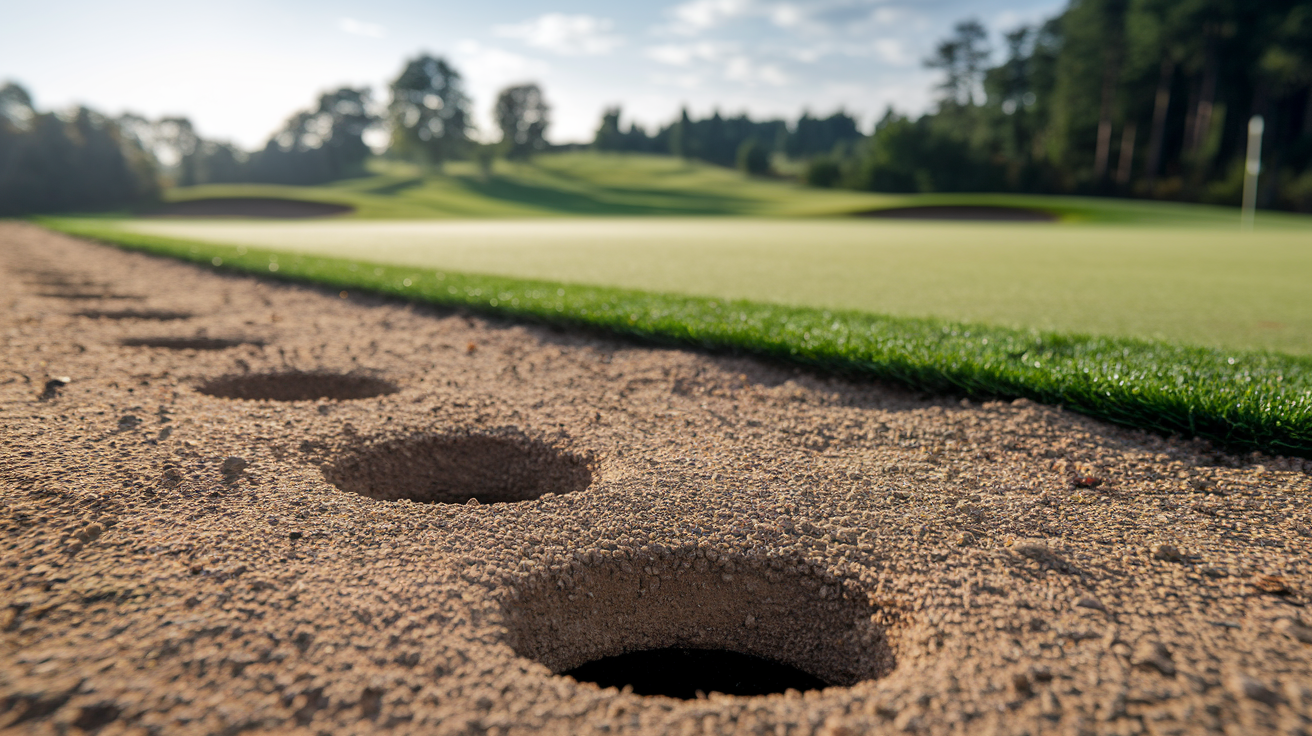
Seasonal maintenance trades away speed, firmness, appearance, and roll quality for a little while so courses end up healthier and more predictable down the line. That’s the trade-off at the core of golf course maintenance, and once you understand it, a rough-looking course doesn’t feel like such a mystery anymore.
Golfers notice the immediate effects right away. Aeration leaves holes scattered across greens and fairways. Topdressing covers everything in a thin layer of sand. Greens run slower for a stretch, approach shots land softer than you’re used to, and the ball roll gets a bit uneven. Some holes or practice areas might close for part of a day. Lies change too, since a ball sitting in a freshly aerated fairway feels different underfoot and off the clubface.
What you don’t always see is the payoff. Aeration relieves soil compaction and opens up the root zone so roots actually get the oxygen they need. Topdressing smooths out bumps and keeps organic matter from piling up into a bigger problem. Overseeding thickens turf in worn spots, and verticutting keeps lateral growth and thatch from choking out healthy grass. Over time you get firmer root zones, faster drainage, more consistent green speeds, and turf that holds up under heat, foot traffic, pests, and disease. Playability isn’t just about how a course looks this week. It’s about how it performs all season.
How much disruption you’ll actually see depends on a handful of moving parts. Treatment intensity matters a lot, and so does grass type, soil conditions, available equipment, and how fast the crew can get through recovery work like brushing, rolling, and watering. Two courses running the exact same aeration program the same week can look and play completely differently because of these variables.
| Maintenance Procedure | Short-Term Effect | Primary Long-Term Benefit |
|---|---|---|
| Micro-tining | Minor surface marking, slight speed dip | Improved air exchange with little disruption |
| Hollow coring | Visible holes, slower greens, uneven roll | Major compaction and thatch relief |
| Topdressing | Sandy surface, temporary bumpiness | Smoother long-term surface, firmer footing |
| Overseeding | Thin turf, restricted traffic areas | Denser turf coverage |
| Verticutting | Shaggy look, loose debris on surface | Reduced thatch, better ball roll consistency |
| Irrigation adjustment | Softer or firmer feel depending on direction | Balanced moisture for root zone health |
When Should Seasonal Golf Course Maintenance Be Scheduled?
(((alt-img2)))
Timing matters just as much as the work itself. Golf course maintenance runs on a calendar, but don’t expect a rigid one. For temperate cool-season courses, spring generally covers March through May, summer runs June through August, fall takes September through November, and winter closes things out from December through February. The heaviest work tends to land in spring and fall. Summer calls for a lighter touch, and winter becomes the catch-all season for projects that don’t fit anywhere else.
Spring Recovery From March Through May
Spring is when courses wake up after winter dormancy. This is usually the window for primary hollow-tine or fairway aeration, overseeding worn traffic areas, and the first round of fertilization. Superintendents also time pre-emergent herbicide applications carefully here, since applying too close to overseeding can backfire badly.
Light verticutting and topdressing start picking up pace as mowing settles back into a regular schedule. It’s also a smart time for drainage inspection. Spring thaw and rain tend to expose weak spots in the system before summer heat shows up and makes everything worse.
Summer Stress Management From June Through August
Summer is about protecting what you’ve got, not pushing big renovation projects. Daily soil-moisture checks become routine, and early-morning irrigation helps turf handle the heat without wasting water during peak evaporation hours.
Mowing heights often get raised slightly during heat stress to ease strain on the plant. Disease prevention programs kick into gear, growth regulators may get applied to manage growth without excessive mowing, and any aeration work usually stays light, like micro-tining, instead of aggressive. Pushing hard renovation during peak play season tends to create more headaches than it solves.
Fall Renovation From September Through November
Fall is the second big maintenance window, and arguably the most important one for setting up next year’s turf health. This is often when the second major aeration and overseeding pass happens, paired with heavier topdressing than you’d see in summer.
Scarifying, when needed, usually happens here too. Root-focused nutrient applications help turf store energy for winter, sodding projects get staged while the grow-in weather is still good, and leaf removal turns into a near-const
Final Words
You’ll see the holes, sand, slower greens, and altered lies when crews are working — that’s the immediate trade-off in playability.
Over time those disruptions give firmer root zones, faster drainage, reduced thatch, and more consistent green speeds, so rounds behave more predictably.
Understanding seasonal maintenance and how it affects course playability helps you pick the right tee time, set expectations, and still enjoy better golf once the work settles. Play on with confidence.
FAQ
Q: What is the short-term trade-off for seasonal maintenance on playing surfaces?
A: The short-term trade-off for seasonal maintenance is that it temporarily reduces speed, firmness, appearance, and ball roll in exchange for healthier, more predictable turf, stronger roots, and better long-term playability.
Q: When should seasonal golf course maintenance be scheduled?
A: Seasonal maintenance should be scheduled around spring and fall for major aeration and overseeding, with daily summer care and winter projects moved off peak play; local climate, turf, and events set exact timing.
Q: How long do aeration, overseeding, and topdressing affect playability?
A: Aeration, overseeding, and topdressing affect playability differently: hollow-tine cores visible 1–7 days, ball roll often affected 7–21 days, ryegrass germinates ~5–10 days, bentgrass ~7–21 days; recovery varies.
Q: Which daily maintenance practices preserve consistent playability?
A: Daily maintenance preserves playability through correct mowing height and frequency, sharp mowers, irrigation timing and hand-watering, brushing and rolling, disease scouting, split nutrients, and routine equipment calibration.
Q: How should playability conditions be measured after maintenance?
A: Playability should be measured with a pre-maintenance baseline and repeated checks at set intervals using Stimpmeter, firmness tests, moisture meters, turf coverage estimates, ball-roll smoothness, and drainage observations.
Q: How can maintenance disruption be reduced without sacrificing turf health?
A: Maintenance disruption can be reduced by choosing lighter, frequent treatments, phasing work across holes, combining operations, prompt core collection and sanding, traffic redirection, and midweek scheduling.
Q: How should golfers be informed about seasonal maintenance?
A: Golfers should be informed with specific, timely notices: announce major work 1–4 weeks ahead, remind 24–72 hours before, list affected holes, visible effects, routing, recovery, and compensation options.
Q: How do seasonal standards differ across greens, tees, fairways, rough, and bunkers?
A: Seasonal standards differ: greens demand daily mowing, rolling, and frequent topdressing; tees and fairways focus on divot recovery and aeration; roughs on consistent cutting; bunkers on frequent raking and edge work.
Q: What resources are needed to deliver seasonal playability standards?
A: Delivering standards needs labor hours, the right equipment widths and calibration, sand and material supply, core collection gear, transport capacity, spare parts, and contingency planning for weather.
Q: What decision framework should guide seasonal course work?
A: A decision framework should diagnose the agronomic issue, define desired playability outcomes, choose the least disruptive effective treatment, set measurable recovery targets, and approve resources and player-notification plans.