

Ever wonder what gives a golf swing its magic? In "Golf Swing Biomechanics Analysis: Elevate Your Game," we break down every little move that powers your shot. From the smooth turn of your hips to the exact moment your club meets the ball, you'll see how tiny changes can lead to big results. Experts use advanced motion systems to capture each detail, helping you understand the science behind that satisfying crack and boost your game.
Core Biomechanical Concepts Underpinning the Golf Swing

Golf is all about smooth, connected motion. To break it down, we first look at two key ideas: kinematics and kinetics. Kinematics is about watching a swing without worrying why it happens. Kinetics, on the other hand, digs into the forces making that swing possible. Imagine how Marie Curie once carried radioactive test tubes without knowing the risk. That story reminds us to see beyond the surface of any movement.
Newton’s laws help explain a golf swing, too. Think of F = ma, this tells us the force behind a club comes from both its weight and how fast it moves. And there’s the idea that every action has a matching reaction, meaning every part of your movement sends a little push back. In a good swing, the motion starts at the hips, flows through the torso, then the arms, and finally reaches the club. Each piece of this chain plays its role to build a powerful hit.
Today’s coaches use cool tools like 3D motion capture and force plates. These gadgets move coaching from just giving advice to using solid, on-point data. They show us exactly how your body works to create that crisp, satisfying hit every time.
Kinematic Profiling in Golf Swing Biomechanics Analysis
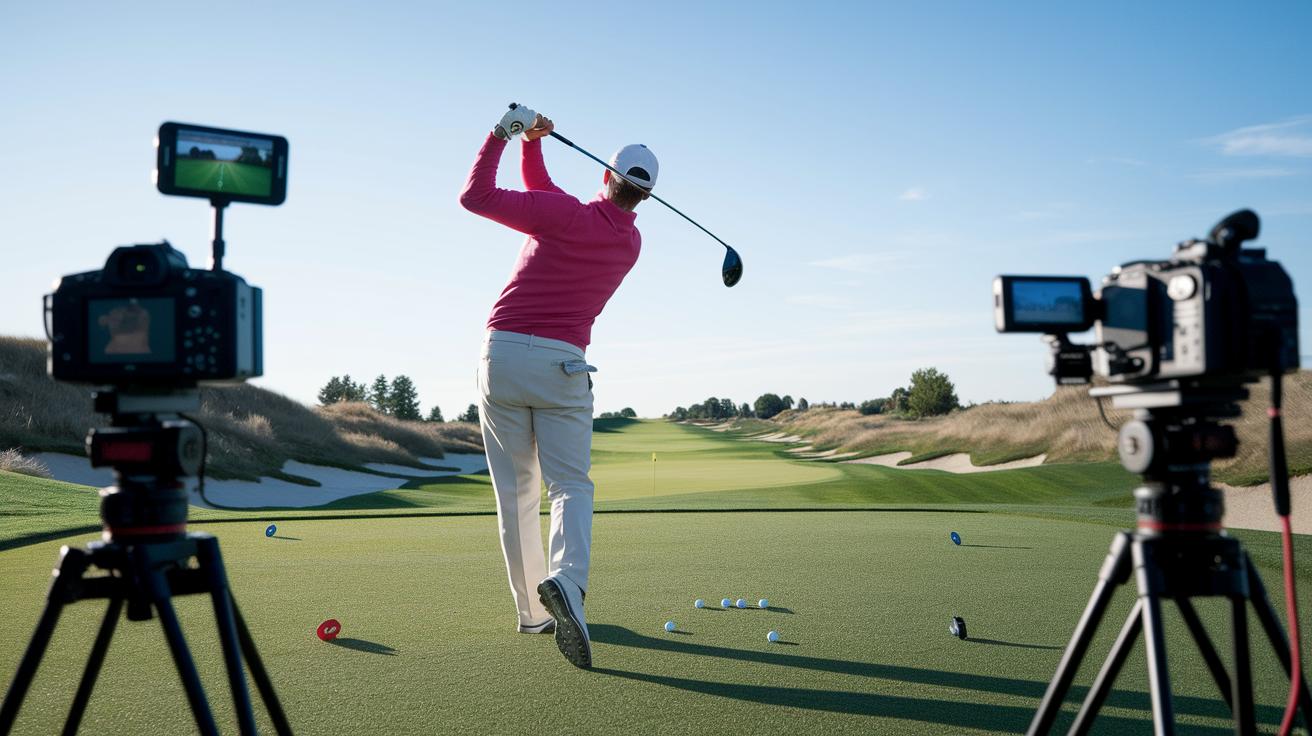
Kinematic profiling breaks down your swing using top-notch motion capture and high-speed video. Coaches use systems like Vicon and Qualisys that record every move at 200–500 frames per second with marker setups. This tech shows every body angle and timing detail. For example, your hips might rotate about 45° while your shoulders turn close to 90°. They also track a wrist lag of around 30° and a club path that stays steady at impact.
Timing details are recorded in milliseconds. It starts with the pelvis at 0 ms, then the torso at 50 ms, followed by the arms at 100 ms, and the clubhead hits peak speed at 150 ms. Think of it like a relay race with smooth handoffs between segments. Coaches use these precise numbers to spot where improvements can be made, while players can fine-tune their posture for a more powerful energy transfer.
This approach turns swing analysis into a clear, data-backed tool, so you know exactly where to adjust for better power and accuracy. It’s like watching a slow-motion replay of every twist and turn, showing you exactly how to elevate your game.
| Variable | Measurement Tool | Pro Range |
|---|---|---|
| Hip Rotation Angle | 3D Motion Capture | 40°–50° |
| Shoulder Turn | High-Speed Video | 80°–100° |
| Wrist Lag Angle | Marker Tracking | 25°–35° |
| Club Path Angle | Motion Analysis Software | –2°–+2° |
Kinetic Evaluation: Ground Reaction and Impact Force Measurement in the Golf Swing

Force plates help us see how a golfer pushes off the ground by tracking vertical and side-to-side forces. They show that the top force can be about 1.2 times the player’s body weight. Pressure mats also come into play, revealing a shift of weight from roughly 40% on the back foot at the start to 60% on the front foot at impact. This kind of info helps coaches fine-tune timing and balance for a solid swing.
Launch monitors catch the force exchanged at impact. They usually record around 2000 N·ms, telling us how much energy transfers when the club meets the ball. At the same time, grip sensors track changes in your hold, with peak forces around 50 to 80 N (Newtons, a unit of force). All these tools combined give a clear picture of how force moves during your swing, offering valuable tips for tiny tweaks and improvements.
| Tool | Description |
|---|---|
| Force Plates | Sample forces at 1,000 Hz for three axes to capture detailed push-off data. |
| Pressure Mats | Map foot pressure changes over time during the swing. |
| Grip Force Sensors | Record dynamic grip changes measured in Newtons. |
| Accelerometers | Measure the deceleration on the club shaft at impact. |
| Launch Monitors | Compute the impact impulse and detail ball-club interaction. |
This detailed analysis helps coaches guide adjustments so every move counts, ensuring each swing is as powerful and controlled as possible.
Rotational Dynamics Review and Torque Production Metrics in the Golf Swing

Torque is like the muscle behind a great golf swing. It’s the force that makes your body twist and drive the club hard and true. At the hips, you can usually count on about 60 Nm, a measure that tells us how much twisting power you have, and the shoulders add around 40 Nm. Think of it like a smooth pivot, where the power builds up just like the tension you feel before opening a tight jar.
Angular momentum is the next key player in your swing. In simple terms, it’s the energy stored by spinning, made from the club’s weight and how fast it rotates (that’s I times ω). With a club moment of inertia of roughly 0.005 kg·m², every swing gathers energy step by step. The power moves upward from the ground, flows through your legs and torso, and finally explodes at impact, pushing clubhead speeds close to 45 m/s for the pros.
Then there’s the D-plane model, which helps show the perfect spot for striking the ball. This model explains the best angle for your clubface so more energy gets transferred to the ball. Even a small misalignment by just a few degrees can make the ball curve into hooks or slices. In short, knowing how torque and angular momentum work together gives you a clearer path to fine-tuning your swing for that extra boost on the course.
Muscle Activation Patterns and Neuromuscular Coordination in the Golf Swing

EMG tests show that the gluteus maximus jumps to its highest point at about 80% of the downswing. This strong movement gives you a rock-solid base for a powerful twist. The latissimus dorsi, a big back muscle helping with shoulder turns, starts ramping up at around 70%. And then the forearm muscles hit their top speed right at impact, adding that extra punch to your shot. One study even found that players had nearly perfect muscle timing, each muscle firing in perfect step to boost club speed, much like a well-rehearsed band nailing every note.
Neuromuscular coordination is what turns raw energy into a smooth, explosive swing. It all kicks off with your pelvis starting to rotate right at the beginning. Then, about 50 milliseconds later, your torso gets in on it. Around 100 milliseconds in, your arms join the action, and the whole sequence peaks at 150 milliseconds as the clubhead bursts forward just before impact. This cycle of stretching and shortening helps speed up shoulder rotation and makes sure energy flows seamlessly through your body. Coaches often use EMG feedback to spot even tiny missteps, guiding players to drills that fine-tune their swing. In simple terms, syncing your muscle action is key to packing more power and control into every shot.
Technology Integration: Sensor Fusion for Golf Swing Biomechanics Analysis

Imagine blending together tools like motion capture cameras, force plates, little sensors that measure movement, and launch monitors to capture every detail of your swing. These sensor fusion techniques grab data from many angles at speeds of 200 to 1,000 times per second. This means that coaches and players can see your swing from start to finish. Systems such as K-Motion and TrackMan work together to record every bit, from the movement of your joints to the force of your impact, in real time.
Processing this data is what really makes the magic happen. Using methods called inverse-dynamics, the system calculates joint forces and clubhead speed by crunching numbers in smart ways. Picture a setup where a motion capture system sends data straight into a computer algorithm, giving you clear feedback on how power moves through your swing. This mix of sensor inputs turns raw data into helpful hints that you can use to fine-tune your game.
Sensor fusion also gives swing analysis a neat boost in accuracy, up by about 4%. This extra edge helps spot tiny flaws in your technique, like small shifts in weight or changes in your body’s balance. Coaches now get live data from devices made for golf swing analysis (check out the latest on golf swing analysis devices) and can even tweak your drills with help from handy golf swing analysis apps. With sharp motion tracking at its heart, this technology is changing how we look at biomechanics, giving you solid, data-backed advice to take your game to the next level.
Technique Optimization Strategies for Golf Swing Biomechanics

Boost your swing by tweaking a few key moves. Coaches say you should turn your hips about 50° to open up your swing, and keeping your wrists at a 30° lag helps store that energy which bursts out at impact. Also, shifting roughly 65% of your weight onto your front foot when you hit the ball can give you a more solid strike.
Try a focused multi-week hip-turn program to help your body turn deeper. Imagine a drill like a swing-path gate exercise that checks your swing at each step, just like staying in your lane on the course. EMG-guided muscle timing drills even let you see real data on how your muscles work together. One easy trick is to record your swing, spot the timing issues, and then work on syncing your muscles just right.
These simple adjustments can boost your clubhead speed by about 5% and slim your path deviation by 2%. They break your swing down into clear, measurable parts so you know exactly what to improve. It’s all about fine-tuning your posture and weight transfer for a smoother, more powerful shot.
Final Words
In the action, we broke down how fundamental principles shape our understanding of the golf swing. We examined core biomechanical concepts and explained kinematic profiling, kinetic evaluation, rotational dynamics, and muscle activation patterns with clear data points. We also explored sensor integration that turns subjective coaching into precise analysis. All these elements help refine technique and boost performance. It’s amazing to see how golf swing biomechanics analysis can transform data into actionable insights for anyone eager to improve their game. Feel good about every swing.
FAQ
Frequently Asked Questions
What are the biomechanical principles of the golf swing?
The biomechanical principles of the golf swing focus on both motion and force.
They examine kinematics—how the body and club move—and kinetics—the forces at work,
following basic physics like F=ma.
What does a golf swing biomechanics analysis PDF include?
A golf swing biomechanics analysis PDF includes sections on kinematic profiling, movement
breakdown, and kinetic evaluation. It explains joint angles, force transfer, and the sequencing
from the pelvis to the club.
How does a science of the golf swing PDF explain swing mechanics?
A science of the golf swing PDF explains swing mechanics by outlining the sequential movement of
the pelvis, torso, arms, and club while highlighting force measurements like ground reaction and
impact loads.
How can I find a golf biomechanics book or certification near me?
A golf biomechanics book or certification near you typically comes from sports science institutes
or golf academies that offer detailed insights into swing analysis and movement mechanics.
What is golf swing kinematics?
Golf swing kinematics studies how the body and club move during the swing without focusing on
the cause of the movement. It uses data from 3D motion capture to measure joint angles and sequence timing.
What is the 80/20 rule in golf?
The 80/20 rule in golf means that a large part of your swing efficiency comes from key movements—
often the hip and core rotation—which deliver most of the performance benefits.
What is the 7/10 rule in golf?
The 7/10 rule in golf suggests that about 70% of your full swing force should be applied during impact
to achieve better timing and ball contact.
Can AI analyze my golf swing?
AI can analyze your golf swing by processing data from motion capture and sensor systems.
It provides clear, real-time feedback on your swing mechanics to help you make quick adjustments.
| Variable | Measurement Tool | Pro Range |
|---|---|---|
| Hip Rotation Angle | 3D Motion Capture | 40°–50° |
| Shoulder Turn | High-Speed Video | 80°–100° |
| Wrist Lag Angle | Marker Tracking | 25°–35° |
| Club Path Angle | Motion Analysis Software | –2°–+2° |